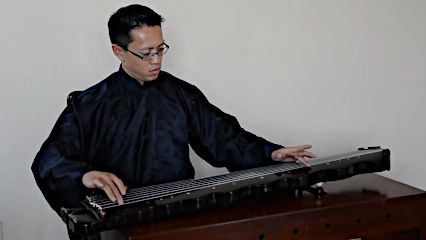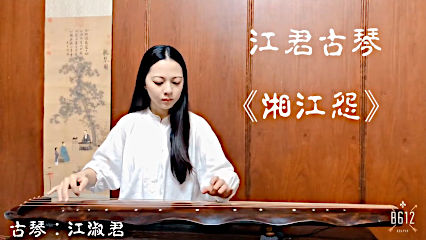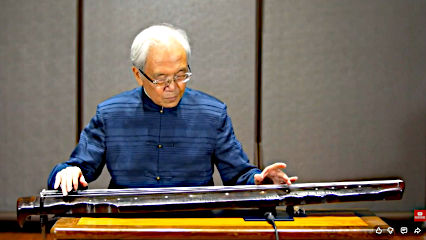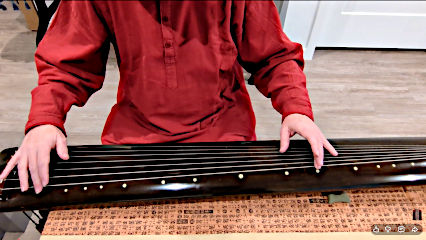
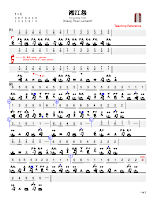
《湘江怨》(pinyin: Xiāngjiāng Yuàn), “Xiang River Lament”, is a yearning, sorrowful piece that is also known as《湘妃怨》 (pinyin: Xiāng Fēi Yuàn), “Lament of the Xiang River Concubines”. Numerous versions of this piece have evolved over the centuries, but recognizable aspects of its melody are found in handbooks dating as far back as 1511.
Background
[Translated from Jiang Shujun’s excellent video description: https://youtu.be/gyz7JHLctU8?si=br3INqrqAwzx5oOh.]
The “Biographies of Exemplary Women” by Liu Xiang of the Han Dynasty states: “Emperor Yao had two daughters, the elder named Ehuang and the younger named Nüying. Yao married them to Shun at the Gui River. After Shun became emperor, Ehuang became empress, and Nüying became a concubine. Shun died in Cangwu, and the two concubines died between the Xiang and Jiang rivers, commonly known as the Xiang River Goddesses.”
The story of the guqin song “Xiangjiang’s Lament” originates from this ancient legend: When Emperor Shun died during his southern tour, the two concubines, filled with grief and longing, wept until their tears stained the bamboo groves, even shedding blood. They eventually died on the banks of the Xiang River. After their deaths, they became the goddesses of the Xiang River, hence the name “Xiangfei” (Xiang Concubines); therefore, this piece is also called “Xiangfei’s Lament.” The “Xiangfei Bamboo” we see today is said to have been formed from the tears of the two concubines.
(For an additional in-depth discussion of the piece, see Lament of the Xiang River Concubines on silkqin.com.)
Lyrics
其一
落花落葉亂紛紛,終日思君不見君。腸欲斷兮腸欲斷,淚珠痕上更添痕。一片白雲青山內,一片白雲青山外。
其二
青山內外有白雲,白雲飛去青山在。我有一片心,無人對君說。願風吹散雲,訴與天邉月。攜琴上高樓,樓高月華滿。
其三
相思彈未終,淚滴氷絃斷。人道湘江深,未抵相思半。海深終有底,相思無邉岸。
其四
君在湘江頭,妾在湘江尾。相思不相見,共飮湘江水。夢魂飛不到,所欠惟一死。
其五
入我相思門,知我相思苦。長相思兮長相憶,短相思兮無盡極。早知如此絆人心,何不當初莫相識。
其六
湘江湘水碧澄澄,未抵相思一半深。每向夢中相見後,令人不覺痛傷心。
冷冷清清,凄凄切切,冷冷清清。
Qí yī
Luòhuā luòyè luànfēnfēn, zhōngrì sī jūn bùjiàn jūn. Cháng yù duàn xī cháng yù duàn, lèizhū hén shàng gèng tiān hén. Yīpiàn báiyún qīngshān nèi, yīpiàn báiyún qīngshān wài.
Qí èr
Qīngshān nèiwài yǒu báiyún, báiyún fēi qù qīngshān zài. Wǒ yǒu yīpiàn xīn, wúrén duì jūn shuō. Yuàn fēngchuī sàn yún, sù yǔ tiān biān yuè. Xié qín shàng gāo lóu, lóu gāoyuèhuá mǎn.
Qí sān
Xiāngsī dàn wèi zhōng, lèi dī bīng xián duàn. Réndào xiāngjiāng shēn, wèi dǐ xiāngsī bàn. Hǎi shēn zhōng yǒu dǐ, xiāngsī wú biān àn.
Qí sì
Jūn zài xiāngjiāng tóu, qiè zài xiāngjiāng wěi. Xiāngsī bù xiāng jiàn, gòng yǐn xiāngjiāng shuǐ. Mèng hún fēi bù dào, suǒ qiàn wéiyī sǐ.
Qí wǔ
Rù wǒ xiāngsī mén, zhī wǒ xiāngsī kǔ. Zhǎngxiàng sī xī zhǎng xiàng yì, duǎn xiāngsī xī wújìn jí. Zǎo zhī rúcǐ bàn rénxīn, hébù dāngchū mò xiāngshí.
Qí liù
Xiāngjiāng xiāng shuǐ bì chéng chéng, wèi dǐ xiāngsī yībàn shēn. Měi xiàng mèngzhōng xiāng jiàn hòu, lìng rén bù jué tòng shāngxīn
Translation:
First Verse
Fallen flowers and leaves flutter in disarray, all day I think of you, yet I cannot see you. My heart is breaking, my heart is breaking, tears add more tears to the already broken marks. A white cloud within the green mountains, a white cloud beyond the green mountains.
Second Verse
White clouds float within and beyond the green mountains, the white clouds fly away, but the green mountains remain. I have a heart full of longing, but no one to tell you. I wish the wind would scatter the clouds, and tell you to the moon in the heavens. I’ll take my zither to the high tower, where the moonlight shines brightly.
Third Verse
The melody of longing is not finished, tears fall and the icy strings break. People say the Xiang River is deep, but it cannot compare to half of my longing. The sea has a bottom, but longing has no shore.
Fourth Verse
You are at the head of the Xiang River, I am at its tail. Longing for each other, yet unable to meet, we drink from the Xiang River together. My soul cannot reach you in dreams, all I lack is death.
Fifth Verse
Enter the gate of my longing, and you will know the bitterness of my longing. Long is my longing, long is my remembrance, short is my longing, yet endless. If I had known it would bind my heart so, why did we never meet?
Sixth Verse
The Xiang River flows clear and blue, yet it cannot compare to the depth of my longing. Every time I see you in my dreams, I am filled with unbearable heartache.
Technique
This piece builds on many of the foundational techniques developed in the previous songs, 《仙翁操》(Xiān Wēng Cāo) and 《古琴吟》(GǔQín Yín), introducing only a few new ones. Most notably, a pair of descriptors are added, 急 (jí) and 從頭再作 (cóng tóu zài zuò). Although these are not really fingering techniques, they are listed in the definition of left hand symbols.
The first, 急 (jí), means to play quickly or with urgency. It doesn’t really change the left or right hand technique itself, but it does subtly affect the timing of the note played. The result should be that the note is played slightly earlier than otherwise expected, as if it is being a bit rushed. This is an expressive tool to draw attention to the note.
Similarly, 從頭再作 (cóng tóu zài zuò) does not specifically change the fingering technique. It simply indicates that the prior section of the music be played another time. This descriptor can sometimes be confusing because it does not explicitly identify the starting position from which to repeat. In some cases, it may be obvious, but not always.
This piece also introduces the symbol for a musical rest (。), the equivalent to the period (.) punctuation mark as written in Chinese. This mark can be interpreted in one of several ways: 1) as a momentary pause, 2) as a longer pause to wait for the sound of the strings to diminish, or 3) as an active silencing of the strings before proceeding. In this particular piece, the first interpretation is used – a momentary pause before proceeding.
Right Hand Techniques (*symbols)
撇 or 擘 (piē or bò) – thumb plucking outward, toward the body (opposite of 托 tuo)
Left Hand Techniques (*symbols)
急 (jí) – to play quickly
從…再作 (cóng … zài zuò) – repeat from the given mark
Additional Videos